Homeowner guide
Sump Pump and Foundation Underdrain Problems in Colorado Springs
Many newer homes here depend on a perimeter drain and either a pump or a shared underdrain line. When either stops working, the basement finds out first.
Have your ZIP code ready. A local restoration pro answers.
Updated October 10, 2026 · 5 min read
Many homes built in the last few decades around Colorado Springs have a perimeter drain around the foundation that carries groundwater away. In some subdivisions that drain feeds a sump pit with a pump, and in others it ties into a shared underdrain line under the street. If the pump fails, loses power, or the underdrain backs up, water rises into the basement. Test your pump before spring, keep the discharge clear, and think about backup power.
How the system works
Expansive clay soils and seasonal groundwater are common in the region, so builders put a perforated drain pipe in gravel around the bottom of many foundations. That foundation drain collects water before it can press against the walls and floor. The water has to go somewhere, and in the Colorado Springs area it usually goes one of two ways.
Sump pit and pump
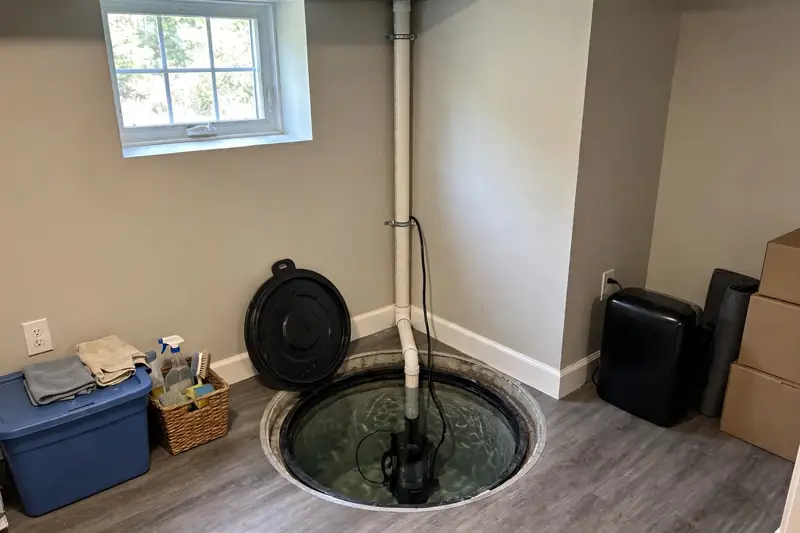
The foundation drain empties into a pit in the basement floor, often in a mechanical room or under a lid in a closet. When the water rises, a float switch turns on a pump that pushes it up a discharge pipe and out of the house.
Gravity underdrain
In many subdivisions, the foundation drain on each lot connects to a shared underdrain pipe that runs under the street and carries groundwater away by gravity. No pump is involved for the homeowner. Communities like Gold Hill Mesa and Falcon Highlands have metro districts responsible for maintaining their underdrains, and homeowners there are told to report problems rather than work on the line themselves. Some homes have both an underdrain connection and a sump as a backup.
If you are not sure which you have, look for a pit with a lid in the basement floor. Your plat notes, HOA documents or metro district can tell you about an underdrain.
Simple sump checks
Do these a couple of times a year, especially before spring snowmelt and before monsoon season.
- Look in the pit. Clear out gravel, sediment and debris. Make sure nothing can jam the float.
- Test the float. Slowly pour a bucket of water into the pit. The pump should start, empty the pit and shut off on its own.
- Listen. A smooth hum is normal. Grinding or rattling, or a hum with no water moving, means trouble.
- Check the check valve. After the pump shuts off, water should not flow back into the pit from the discharge pipe.
- Go outside. Find where the discharge comes out. It should be clear, unfrozen and pointed away from the house, onto ground that drains away.
- Check the plug. The pump should be plugged into a working GFCI outlet, ideally one not shared with other appliances.
Winter discharge problems
A discharge line that runs across the yard can freeze in a cold snap. When it does, the pump runs against a blocked pipe and the pit can overflow. Some homeowners add a freeze relief fitting near the house so water can escape if the line ices up. Keep snow from piling over the outlet as well.
Where the water must not go
Do not run the sump discharge into a laundry sink, floor drain or cleanout. Those usually connect to the sanitary sewer. Colorado Springs city code lists sump discharges among the kinds of water that need approval before they enter the wastewater system. Also avoid pointing the outlet at a neighbor's yard, a sidewalk that freezes, or right back toward your own foundation.
Water still spreading? Talk to a local restoration pro now.Have your ZIP code ready. A local restoration pro answers.
Call (719) 555-0142Backup power
A sump pump is most needed during heavy storms, and those are often the same storms that knock out power. A pump without power is just a pipe in a hole.
| Option | What to know |
|---|---|
| Battery backup pump | A second pump on its own battery that runs if the main pump or power fails. Run time depends on the battery and how often water comes in. |
| Water powered backup | Uses city water pressure to pull water out of the pit, with no electricity. Needs a municipal water supply and enough pressure, and uses water while it runs. |
| Portable generator | Can power the main pump during a long outage. Never run it indoors or in an attached garage because of carbon monoxide. |
| Alarm | A high water alarm in the pit, or a Wi-Fi sensor that texts you, gives early warning when you are away. |
Homes on private wells, common in Black Forest and parts of the eastern county, cannot use a water powered backup, since the well pump also needs electricity.
Signs your underdrain is not keeping up
If your home ties into a shared underdrain, you cannot test it like a pump, but you can watch for signs:
- Dampness along the bottom of basement walls after storms, when the basement used to stay dry.
- Water coming up through the slab or around the edges of the floor.
- A sump that runs much more often than it used to, if you have one as backup.
- Neighbors on the same street reporting the same thing.
Report problems to your metro district or HOA in writing, and keep photos with dates. A KRDO report on Falcon Highlands showed how confusing underdrain responsibility can be for homeowners, so it helps to know who maintains yours before you need them. Homeowners in Falcon, Gleneagle and Stetson Hills can usually find this in their community documents.
When the basement floods anyway
Pumps fail. Power goes out. Underdrains clog. If water is on the floor:
- Do not step in it if outlets, cords or appliances are in the water. Shut power at the panel only if you can reach it from a dry spot.
- If the pump has stopped, check the breaker and GFCI before assuming it has died.
- Move what you can off the floor and take photos.
- Get water out quickly. Finished basements hold water in carpet pad, the bottom of the drywall and the insulation behind it. Our emergency water extraction and basement flooding pages explain what happens on the first visit.
Our post on basement flood cleanup cost factors covers how the source of the water affects the scope, and expansive soil and basement water explains why so many local homes need these drains in the first place.
Need someone to look at it today?Tell them your ZIP and what happened. A local pro picks up.
Call (719) 555-0142Insurance and sump failures
Basement water from a failed sump pump or a backed up drain is often excluded from a standard homeowners policy. Many insurers sell a water backup endorsement that covers sump overflow and drain backup up to a set limit. If you have a sump and a finished basement, it is worth a call to your agent to see what your policy says. Groundwater seeping through the walls and surface flooding are treated separately and are usually excluded unless you carry flood insurance.
Water still spreading? Talk to a local restoration pro now.Have your ZIP code ready. A local restoration pro answers.
Call (719) 555-0142Sources and official resources
- Contractor license lookup (Pikes Peak Regional Building Department)
- Homeowners insurance help (Colorado Division of Insurance)
- IICRC: restoration industry standards body
- Flood insurance basics (FEMA FloodSmart)
- A Brief Guide to Mold, Moisture and Your Home (EPA)
- Colorado Springs weather warnings (National Weather Service, Pueblo)
Related
Services and areas for this guide
Homeowner guides
Keep reading

FAQ
Common questions
Straight answers to what Colorado Springs homeowners ask most. Still unsure? Call and ask a local pro.
Call (719) 555-0142How often should my sump pump run?
It depends on the lot and the season. Some pumps sit idle most of the year and run after storms or snowmelt. Others cycle often because groundwater stays high. What matters most is a change from normal, such as a pump that suddenly runs constantly or stops running when it usually would.
Can I run my sump discharge into the laundry sink or floor drain?
No. Those drains usually connect to the sanitary sewer, and Colorado Springs city code treats sump discharge as water that needs approval before it goes into the sewer system. Send it outside to a spot that drains away from your house and your neighbor's.
Who fixes the underdrain under the street?
It depends on the subdivision. In many communities a metro district maintains the shared underdrain, and homeowners report problems rather than work on it. Check your plat notes, HOA documents or metro district website, or call the district directly.
Does homeowners insurance cover a basement flooded by a failed sump pump?
Standard policies often exclude it. Many insurers offer a water backup and sump overflow endorsement that adds this coverage up to a limit. If you have a sump, it is worth asking your agent whether your policy includes one.
How long does a battery backup sump pump last during an outage?
It varies with the battery size, the pump and how often water comes in. A pump that cycles every few minutes drains a battery far faster than one that runs once an hour. Test it under real conditions, and ask the installer what to expect for your setup.
My basement is dry but the pump is noisy. Should I worry?
Grinding, rattling or a pump that hums without moving water are early warning signs. The impeller may be clogged or the motor wearing out. Have it checked before the next wet season rather than waiting for a failure.
Water where it shouldn't be?
Call now and a licensed restoration pro near you can walk you through the next hour and set up a visit.