Homeowner guide
Window Well Flooding in Colorado Springs: Covers, Drains and Egress Safety
A window well is a hole next to your foundation that catches snow, hail and runoff. Here is how water gets from the well into your basement and how to stop it.
Have your ZIP code ready. A local restoration pro answers.
Updated November 9, 2026 · 5 min read
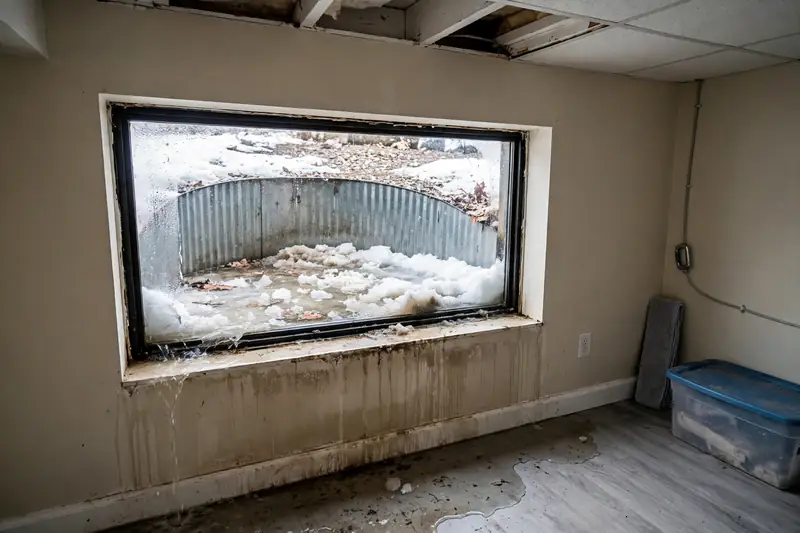
Window wells flood in Colorado Springs when snowmelt, a heavy thunderstorm or piled-up hail fills the well faster than it can drain, and the water rises until it seeps around the basement window or pushes through it. Our clay soils drain slowly, and snow often melts within days of falling, so the same wells can fill several times a winter. A good cover, a working drain, clean gravel and a yard that slopes away from the house keep most wells dry, and none of those fixes should block the window as an emergency exit.
Why window wells fill up here
Snowmelt, over and over
Front Range snow tends to come in bursts and then melt in the sun. Snow that drifts into an open window well, or gets shoveled or plowed against the house, melts during the day and sits in the bottom of the well. If the gravel below is still frozen or the soil is saturated, it has nowhere to go. Repeat that across a winter and wells that look fine in summer start leaking in March.
Spring snowstorms are often heavy and wet, which makes them a common time for well flooding. A big March or April storm followed by a warm stretch dumps a lot of water against the foundation at once.
Summer storms and hail
July and August thunderstorms can drop heavy rain in a short time. Wells next to a downspout, a patio that drains toward the house, or a neighbor's yard that slopes your way catch that runoff fast. Hail adds another layer: a well filled with hailstones is basically a well full of ice that melts all at once. The storm and flood damage page covers what heavy summer storms do beyond the window wells.
Clay soil
Much of the area has expansive clay soils that swell when wet and drain slowly. Water that should soak away under the well sits instead, and the wet clay presses against the foundation. That is also why many newer subdivisions have foundation drains. The post on expansive soil and basement water explains how those soils affect the whole foundation, not just the wells.
How water gets from the well into the basement
- Around the window frame, when water rises above the bottom of the frame and finds gaps in caulk or flashing.
- Through the window itself, if the glass, seal or frame fails under the weight of standing water.
- Between the well liner and the foundation, if the well was not sealed or fastened tightly to the wall.
- Through the foundation wall below the window when the soil is saturated.
Finished basements in neighborhoods like Banning Lewis Ranch, Stetson Hills and around Falcon often have bedrooms with egress windows, so a flooded well usually means wet carpet, wet drywall and a soaked bedroom.
Not sure how bad it is? A short call usually tells you.Have your ZIP code ready. A local restoration pro answers.
Call (719) 555-0142Window well covers
A cover keeps snow, leaves, hail and most rain out of the well. It is one of the simplest fixes available.
| Cover type | Pros | Watch for |
|---|---|---|
| Clear polycarbonate dome or flat | Lets light in, sheds water and snow | Must be sized to the well; can crack in big hail |
| Metal grate | Strong, keeps people and pets out | Lets snow and rain straight through |
| Grate with clear panel on top | Strength plus water shedding | Heavier, check it still opens easily |
| Custom-fit cover | Fits odd shapes tightly | Must still open from inside |
The egress rule that comes first
If the window is an egress window for a bedroom, the well is part of a fire escape route. Under current residential code, a cover or grate over an egress well has to open from inside without a key, tool or special knowledge, and without more force than it takes to operate the window. Do not screw a cover down, pile anything on it or let it freeze shut. After a snowstorm, check that egress covers can still be pushed open.
Egress wells also have size rules in current code. They generally need at least 9 square feet of floor area with no side shorter than 36 inches, and a well deeper than 44 inches needs a permanent ladder or steps. Older homes may have smaller wells built under older codes. If you are replacing a well or adding a basement bedroom, check with the Pikes Peak Regional Building Department about permit and code requirements.
Window well drains
Many wells have a drain at the bottom, often a pipe that runs down through the gravel to the foundation drain or sump system. When it works, water drops through the gravel and away. When it clogs, the well becomes a bathtub.
- Check the drain by pouring a bucket of water into the well on a dry day. It should drain away in minutes, not hours.
- Keep the drain cap clear of leaves and silt. A screened cap or a layer of clean gravel over it helps.
- Do not cover the drain with soil or landscape fabric.
- If you have a sump pump, make sure it is running. A failed sump means the window well drain has nowhere to empty. See sump pump and foundation underdrain problems.
Grading, gutters and downspouts
Most window well flooding starts with water that never should have reached the well.
- Extend downspouts several feet away from the house, and keep them away from wells.
- Make sure soil around the foundation slopes away from the house, not toward it.
- Fill low spots where water collects near wells.
- Keep gutters clear so they do not overflow onto the wells.
- Do not shovel or plow snow against the house or into the wells.
Need someone to look at it today?Tell them your ZIP and what happened. A local pro picks up.
Call (719) 555-0142What to do if a window well is flooding now
- Stay safe. Do not stand in water near outlets or extension cords in the basement.
- Bail or pump out the well from outside if you can do it safely. A small utility pump works well.
- Lay towels or a barrier along the inside of the window to slow the water.
- Move belongings away from the wall and off the floor.
- Take photos of the well, the window and the interior damage.
- Call for emergency water extraction if water is already on the carpet.
Water still spreading? Talk to a local restoration pro now.Have your ZIP code ready. A local restoration pro answers.
Call (719) 555-0142Once water is in, carpet pad and the bottom of drywall soak it up quickly. A basement flooding crew can extract the water, pull wet pad, open walls where needed and dry the space so it does not turn into a mold problem.
What drives the cost of cleanup
The company that inspects gives a written figure before work starts. It depends on how much of the basement is wet, finished vs unfinished space, carpet and pad, drywall height affected, how long water sat, whether the water picked up soil and debris, and whether repairs to the well or window are part of the job. Insurance terms matter here too, since many policies handle surface water and groundwater differently from a burst pipe.
Water still spreading? Talk to a local restoration pro now.Have your ZIP code ready. A local restoration pro answers.
Call (719) 555-0142Sources and official resources
- Contractor license lookup (Pikes Peak Regional Building Department)
- Homeowners insurance help (Colorado Division of Insurance)
- IICRC: restoration industry standards body
- Flood insurance basics (FEMA FloodSmart)
- A Brief Guide to Mold, Moisture and Your Home (EPA)
- Colorado Springs weather warnings (National Weather Service, Pueblo)
Related
Services and areas for this guide
Homeowner guides
Keep reading

FAQ
Common questions
Straight answers to what Colorado Springs homeowners ask most. Still unsure? Call and ask a local pro.
Call (719) 555-0142Can I bolt down or lock my window well cover for security?
An egress well cover needs to open from inside without a key, tools or special knowledge, and without more force than it takes to open the window. Bolting it shut or putting a heavy grate on it can trap someone during a fire. Choose a cover made for egress wells and check that a child or older adult could push it open.
My window well has no drain. Is that a problem?
Not always, since some wells rely on a deep gravel bed that lets water soak into the soil. In tight clay soils, though, water may sit in the gravel instead of draining away. If your well holds water after storms, have someone check whether a drain to the foundation drain system can be added.
Does homeowners insurance cover water that came in through a window well?
Coverage depends on how the water got there and your policy wording. Many standard policies exclude surface water and groundwater, which is how window well flooding is often classified. Some policies or endorsements treat it differently, so ask your agent before a storm, not after.
How often should I clean out my window wells?
Check them each fall after the leaves drop and again in spring after the last big snow. Clear out leaves, pine needles, trash and any dirt that has washed in so the gravel stays a few inches below the window frame. Look after any hailstorm too, because piled hail melts like a small snowbank.
Should the gravel in a window well be level with the window?
No. The gravel should sit several inches below the bottom of the window frame. When gravel or soil builds up to the sill, even a small amount of standing water can reach the window and seep around the frame.
Water where it shouldn't be?
Call now and a licensed restoration pro near you can walk you through the next hour and set up a visit.