Homeowner guide
How Long Does It Take to Dry a House After Water Damage in Colorado Springs?
Low humidity is a real advantage here, but wet framing, slabs and insulation still need airflow, dehumidifiers and daily readings to dry on schedule.
Have your ZIP code ready. A local restoration pro answers.
Updated September 28, 2026 · 5 min read
A clean-water drying job in a Colorado Springs home usually takes 3 to 5 days once extraction is done, and our dry air often pushes it toward the faster end. That is a typical range, not a promise. Dense materials like slab concrete, hardwood, plaster and stacked framing take longer, and a job that started late or involved dirty water can run well past a week. The only reliable answer comes from moisture readings taken in your house each day.
Why the dry air here helps
Colorado Springs sits around 6,000 feet with low humidity for most of the year. Dry air pulls moisture out of wet surfaces faster than the muggy air in a Gulf Coast or Midwest summer. In practical terms, that means:
- Surface water on drywall and trim tends to flash off quickly once air is moving.
- Dehumidifiers have less background moisture to fight, so they can focus on what is coming out of the materials.
- Small spills caught in minutes, like a sink overflow onto tile, often dry with towels and a fan.
That is the good news. It is also where a lot of homeowners go wrong.
Why it does not replace drying equipment
Dry outdoor air works on surfaces. Water damage lives inside materials. The back side of drywall, the bottom plate of a wall, the pad under carpet, insulation in a wall cavity and the top inch of a basement slab are all places where the air does not reach on its own.
A few common mistakes:
- Opening the windows and calling it done. In winter that cools the house, and cold air dries slowly. In summer an afternoon storm can bring in humid air right when you do not want it.
- Judging by touch. A wall can feel dry to your hand while the bottom foot reads soaked on a moisture meter.
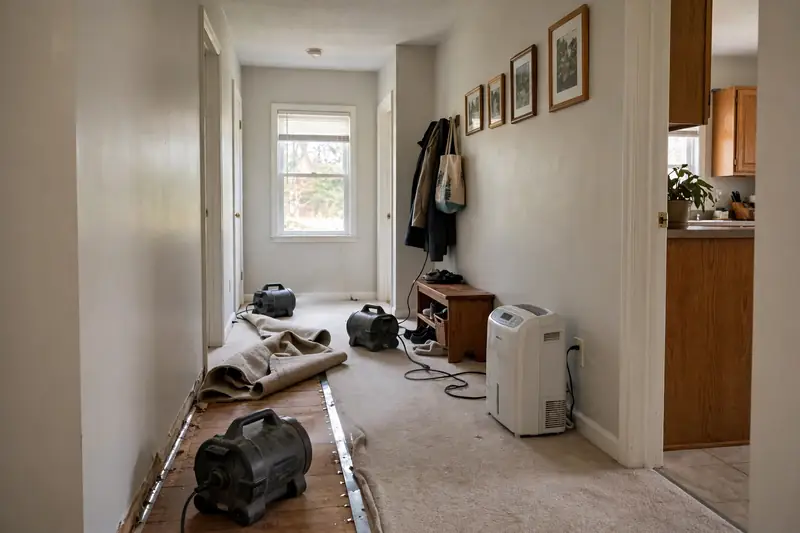
- Running a household dehumidifier. Home units are sized for a musty basement, not for pulling gallons out of a flooded room.
- Leaving carpet pad in place. Pad holds water like a sponge and keeps the subfloor wet underneath it.
Professional drying uses air movers to push air across wet surfaces, commercial dehumidifiers to capture what comes off, and in some cases heat or targeted systems that blow air into wall cavities. A local restoration pro sets that up based on how much water there is and what it soaked into. Our page on water damage restoration covers how the full process runs from first call to final readings.
Water still spreading? Talk to a local restoration pro now.Have your ZIP code ready. A local restoration pro answers.
Call (719) 555-0142What slows drying down
| What you have | Why it slows things down |
|---|---|
| Concrete slab or basement floor | Concrete holds water deep and gives it up slowly |
| Hardwood or engineered wood | Wood has to dry gradually or it cracks and cups |
| Plaster walls (common in older homes) | Thick, dense and slow compared with drywall |
| Multiple layers of flooring | Each layer traps water under the one above it |
| Insulated exterior walls | Wet insulation shields the inside of the cavity from airflow |
| Cabinets and built-ins | Toe kicks and cabinet backs trap water against the wall |
| Late start | Water has had time to wick higher and soak deeper |
| Dirty water | Category 2 or 3 water usually means removal instead of drying |
Time matters more than air
The single biggest factor in drying time is how long the water sat before anyone started removing it. Drywall wicks water upward over hours. Wood absorbs it over days. If a washing machine leak ran all weekend while you were away, it will take longer to dry than the same amount of water caught in ten minutes.
That is why emergency water extraction comes first on any job. Every gallon pulled out with a truck-mounted or portable extractor is a gallon the dehumidifiers do not have to remove from the air.
Basements are their own case
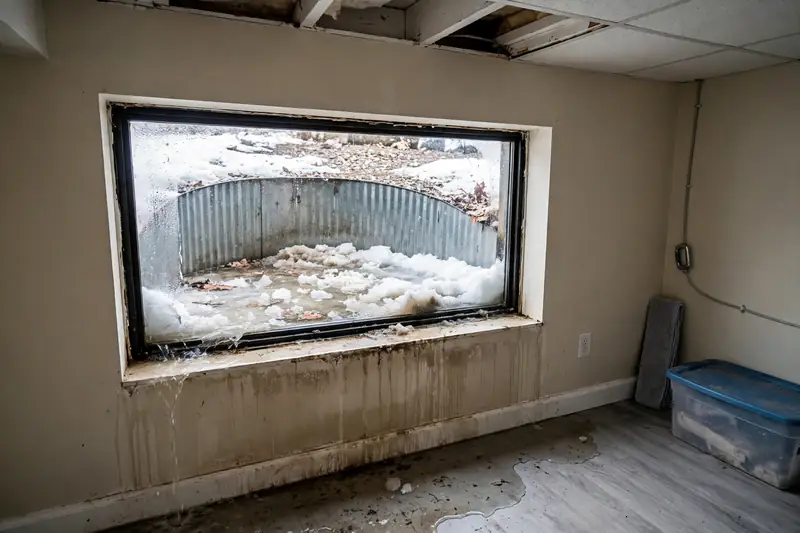
Finished basements are common in newer neighborhoods like Briargate and out toward Falcon. When water gets under carpet and behind finished walls on a slab, drying usually takes longer than on an upper floor. Cold slab temperatures in winter slow evaporation too. If water came in from outside, through a window well or the foundation, the source has to be dealt with first or the job never finishes. The basement flooding page goes into that in detail.
What a typical drying timeline looks like
Every house is different, but a clean-water job that starts fast often runs like this:
- Day 1: Stop the source, extract standing water, pull wet pad, remove baseboards where needed, set air movers and dehumidifiers, take first readings.
- Day 2: Readings show drywall and framing dropping. Equipment gets moved to focus on the wettest spots.
- Day 3: Most drywall and wall framing is close to dry. Slab, hardwood and cabinets may still be wet.
- Days 4 to 5: Final materials reach target. Equipment comes out once readings are at or near the dry standard for that material.
If readings stall, the crew should tell you why. It might be water trapped under vinyl plank, a wet wall cavity that needs to be opened, or a slow leak that is still running.
How to tell if your house is really dry
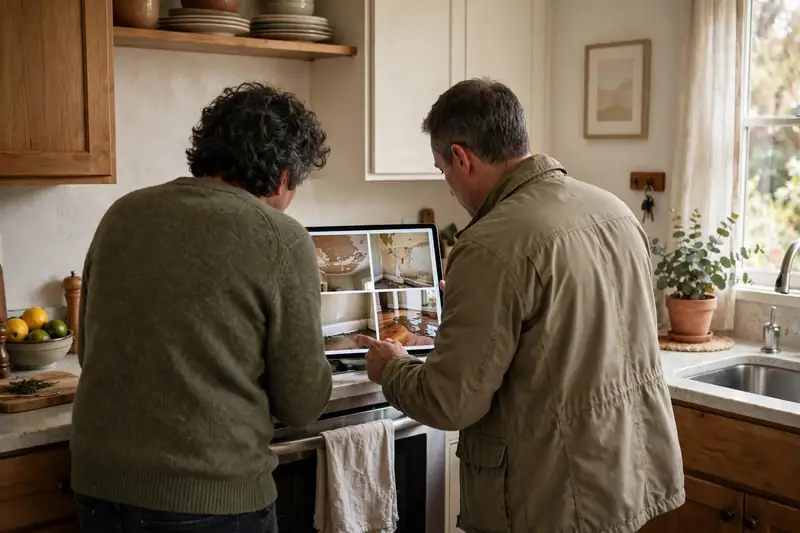
Ask for the numbers. A good crew marks reading points on a moisture map, logs them each visit and compares them with a dry reference spot in an unaffected room. The job is done when the wet areas match the dry reference, not when they look and feel fine.
If equipment gets pulled while readings are still high, materials can stay damp behind paint and trim. In our climate people tend to assume it will finish drying by itself. That is how hidden mold starts, which we cover in mold after water damage in a dry climate.
Need someone to look at it today?Tell them your ZIP and what happened. A local pro picks up.
Call (719) 555-0142What drives the cost of drying
Drying jobs are not priced by the day alone. The company that inspects puts the real figure in writing before work starts, and it usually depends on:
- The water category (clean, gray or black water)
- How many square feet and how many rooms are wet
- What got wet: drywall, slab, hardwood, cabinets, insulation
- Finished or unfinished space
- How long the water sat before extraction
- Whether it is drying only or also tear-out and rebuild
- After-hours or holiday response
- Your insurance policy and deductible
For more on the difference between getting the water out and putting the house back together, read water mitigation vs restoration.
Bottom line for Colorado Springs homeowners
The climate gives you a head start, not a free pass. Get standing water out fast, get professional drying equipment running, and do not let anyone shut it down until the readings say the job is finished.
Water still spreading? Talk to a local restoration pro now.Have your ZIP code ready. A local restoration pro answers.
Call (719) 555-0142Sources and official resources
Related
Services and areas for this guide
Homeowner guides
Keep reading
FAQ
Common questions
Straight answers to what Colorado Springs homeowners ask most. Still unsure? Call and ask a local pro.
Call (719) 555-0142Can I turn off the drying equipment at night to save power?
It is better not to. Drying works because air movement and dehumidification run continuously, and shutting them down lets moisture move back into the surface of the material. Ask the crew which units can be turned down if noise is the issue, rather than switching everything off.
Why does the crew keep coming back every day?
Each visit is to take moisture readings at the same marked points and adjust the equipment. Those readings tell the crew when a wall or floor has reached its dry target and the gear can come out. They also document the job for your insurance claim.
Do I have to leave the house while it dries?
Most families stay home during a clean-water drying job, though the fans are loud and the affected rooms are off limits. Sewage, heavy mold or a job that requires tearing out a kitchen can change that. Many homeowners policies include additional living expense coverage if the house is not livable, so check yours.
Will my wood floors be dry when the walls are?
Often not. Hardwood and the subfloor under it usually take longer than drywall, and some floors need special drying mats. The crew should track the floor separately and tell you if it is drying, holding steady or cupping.
Water where it shouldn't be?
Call now and a licensed restoration pro near you can walk you through the next hour and set up a visit.